CXL Institute Growth Marketing Minidegree | Week 7 | REVIEW


There are several characteristics of an effective landing page. The landing page shortens users' journeys from clicks to conversion. It follows up on "promises" made in the ad source, speaks to user motivation, addresses barriers, answers important questions, creates clarity, and creates a clear path to the conversion goal.
THE OPTIMISATION PROCESS
The optimization process is a six-step process that leads to the total optimization of a landing page. The optimization process is as follows:

1. Conduct Research: Conducting research is the most important aspect of the optimization process. Research means the process of gathering, managing, and interpreting data to make better decisions. There are two forms of conducting research: qualitative research and quantitative research.
2. Form/Validate Hypothesis: After gathering the relevant research, the next step is to validate the hypothesis. The hypothesis can be formed by asking relevant questions based on the data gathered.
3. Create Treatment: Here, you will take care of the data.
4. Conduct Experiment: After treating the data, you'll start experimenting. This involves testing different variations of the data.
5. Analyze Experiment Data: it simply means making sense of the data. Here is where you will interpret the data.
6. Conduct a Follow-up experiment: The importance of a follow-up experiment is to "Trust but Verify" it's testing till you've reached your expected goal.
When optimizing, it is imperative to take cognizance of the various modes of thinking, which is intuitive thinking and analytical thinking. Intuitive thinking, otherwise known as fast thinking, is something that happens to you; it is automatic and happens to our emotional subconscious. While analytical thinking, otherwise known as slow thinking, is something that you do, it takes effort and is logical. The law of least effort states that we are inclined to something with the least effort.
Human biases are worthy of recognition when optimizing a landing page; some biases include priming, framing, and WYSIATI. Priming states that exposure to a stimulus influences the response to a subsequent stimulus. Framing states that the way you deliver the message has a direct impact on how it is perceived. Lastly, WYSIATI is an acronym for what you see is all there is.
BRAIN CHEMICAL – DOPAMINE AND CORTISOL
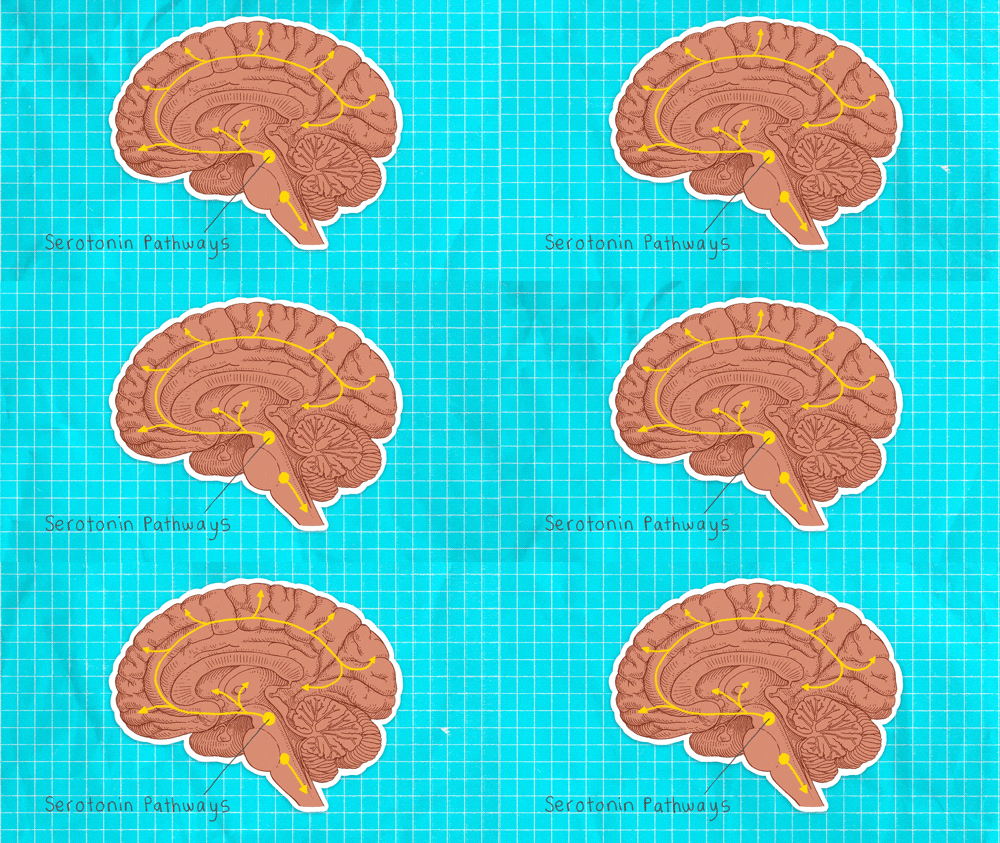
The field of neuroscience talks about the activities and triggers of the brain. To better understand our users' brain response or psychology, we'll need to look at dopamine and cortisol and how they impact our user's decisions. Dopamine is a reward mechanism; it is released when we are exposed to a reward stimulus. Although it does not equal happiness, it produces the joy of finding things that meet our individual needs.
Dopamine has a negative error that triggers our brains when our expectations of reality don't match our reality experience. While the cortisol is the stress hormone that produces the "oh-no I have to do something now" feeling. It's a built-in alarm system that helps us avoid pain, as well as things that are a threat to our survival.
There are some cortisol triggers to watch out for when optimizing a landing page for conversion. The triggers are ambiguity (lack of clarity), disempowerment (I'm not in your country), multitasking (trying to solve several tasks at once), too much pressure (forced to make a decision), and the use of words (spam). These triggers lead to a low conversion rate and should be avoided.
WIREFRAMING AND INFORMATION HIERARCHY
A wireframe is a visual guide that represents the skeletal framework of your page or website. It's an architecture that represents the information hierarchy on your page. Wireframes help in visualizing the landing page earlier on, it also helps in prioritizing content and builds structure, and it makes it easier to align copy and design.
It is important to have an information hierarchy of a landing page because it answers two main questions: what question is most important? And how many questions are necessary? Having a lot of information on your landing page is great, as long as it is relevant, logical, and concise. Too much information at once creates confusion and leads to a high bounce rate, while not enough information creates irritation and a higher bounce rate. The information needs to be moderate. Information hierarchy helps you in finding the right balance.

There are a plethora of qualitative sources of data available to the marketer when carrying out market research. Some sources to look at are review websites, session recordings, heat maps, feedback polls, and user testing. He should also ask the customer success team, the sales team, and customers to get information about the market's needs.

IN CONCLUSION
The landing page optimization topic is of special interest to me because I'm a website and funnel builder. This week, I covered a lot about users' psychology, optimization tips for a landing page, including landing page copywriting. The growth marketing min-degree is getting interesting, I can’t wait to explore more courses.
inspiration: www.linkedin.com/pulse/cxl-institute-growth-marketing-week-8-review-victor-akujuo-c-/


Comments
Post a Comment